For years, builder-grade cabinetry operated on a predictable formula: cut unit costs to the bone, specify standard friction hinges and basic roller slides, and offer soft-close mechanisms as a paid upgrade. In today’s competitive residential and multifamily markets across Minnesota, that approach is actively costing contractors money.
Today’s buyers and tenants notice the difference the moment they tour a spec home or model unit. The sharp clatter of a slamming cabinet door immediately signals corner-cutting, while a smooth, controlled glide communicates structural quality before a client even looks at a spec sheet. Soft-close hinges and drawer glides are no longer luxury upsells—they are critical risk-mitigation tools that protect margins, reduce callbacks, and simplify job-site operations.
Here is why general contractors, home builders, and multifamily developers are moving away from friction hardware and demanding integrated soft-close hardware as a baseline specification.
1. Eliminating the Job-Site Callback and Warranty Cycle
Every general contractor knows that punch-list work and warranty visits eat into net margin. When standard hinges and side-mount roller glides are installed, mechanical impact is constant. Over hundreds of cycles during construction, staging, and initial move-in, repeated slamming loosens face-frame screws, rattles drawer fronts out of alignment, and stresses corner joints.
Integrated hydraulic dampening eliminates this kinetic shock:
- Reduced Joint Stress: Soft-close hardware absorbs closing momentum before the door or drawer impacts the frame, protecting mortise, tenon, and dovetail joints from racking.
- Fastener Integrity: Standard hardware vibrations frequently back out hinge plate screws from the cabinet box. Hydraulic deceleration stops that vibration at the source.
- Fewer 30-Day and 11-Month Callbacks: By preventing door sag and out-of-square drawer fronts caused by forceful closures, field crews spend less time on routine adjustments during warranty walkthroughs.
When a kitchen maintains its factory alignment through move-in and the critical first year of occupancy, contractor reputations stay intact and service overhead drops.
2. Elevating Perceived Value in Spec and Multifamily Builds
Buyers and prospective renters do not inspect fastener gauges or evaluate edge-banding chemistry during a walk-through. They interact with touchpoints: exterior doors, plumbing fixtures, and cabinet hardware.
When a prospect pulls open a kitchen drawer, their evaluation is tactile. A light push that results in a smooth, quiet self-close delivers immediate perceived value. In multifamily properties, this feature serves a dual operational purpose: it dampens noise transmission through shared party walls and cabinet chases, improving tenant satisfaction and reducing noise complaints in dense developments.
Treating soft-close as an add-on creates friction in sales and bidding. Standardizing the feature across all units ensures uniform quality, streamlines design sign-offs, and removes the risk of buyers feeling nickel-and-dimed on punch-list items they consider modern essentials.
3. The Structural Synergy: Plywood Boxes and Dovetail Drawers
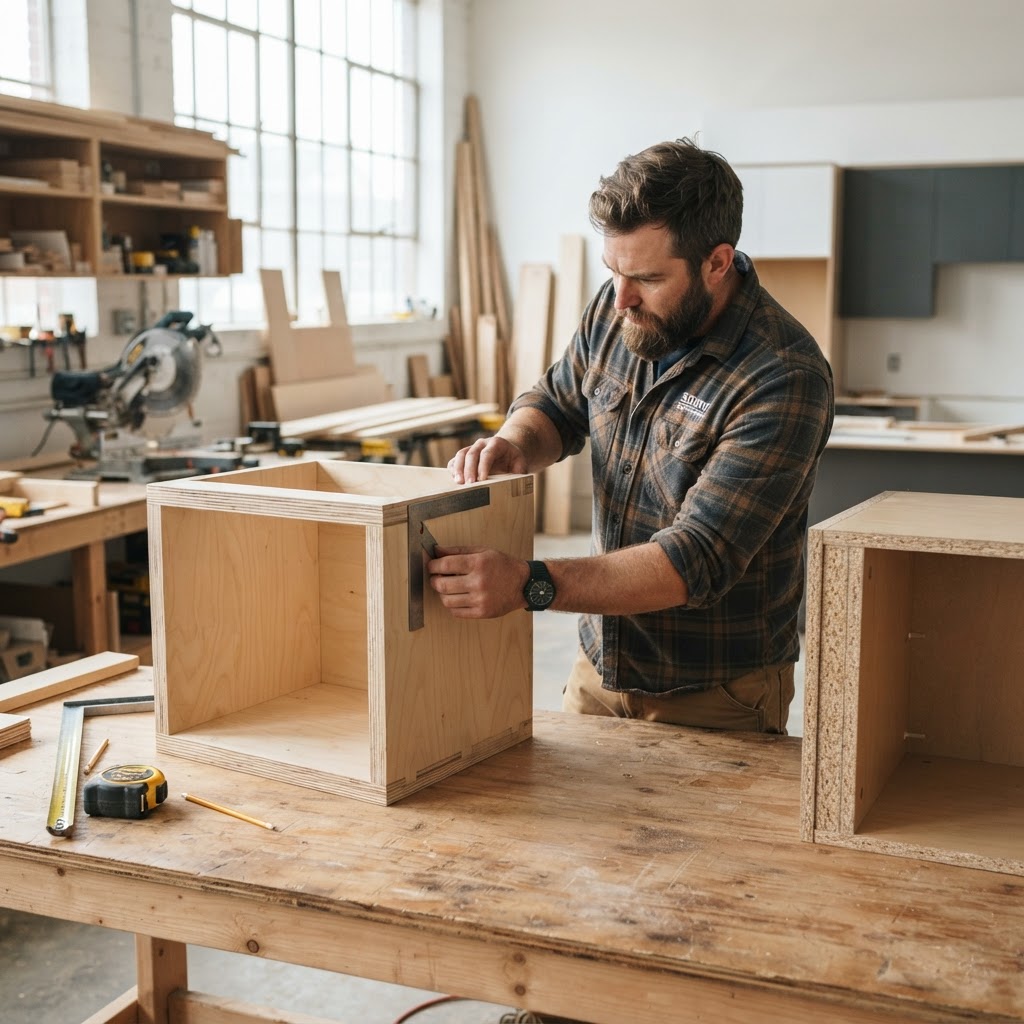
Hardware does not work in isolation. Soft-close slides and hinges deliver the greatest return on investment when paired with robust cabinet construction. When high-tension soft-close mechanisms are anchored into low-density particleboard or medium-density fiberboard (MDF), the continuous pull can cause mounting holes to strip over time.
To ensure durability, hardware specifications must align with cabinet box construction:
- All-Plywood Construction: Plywood core provides superior screw-holding strength, ensuring concealed soft-close hinges stay anchored without wallowing out screw holes under repeated cycling.
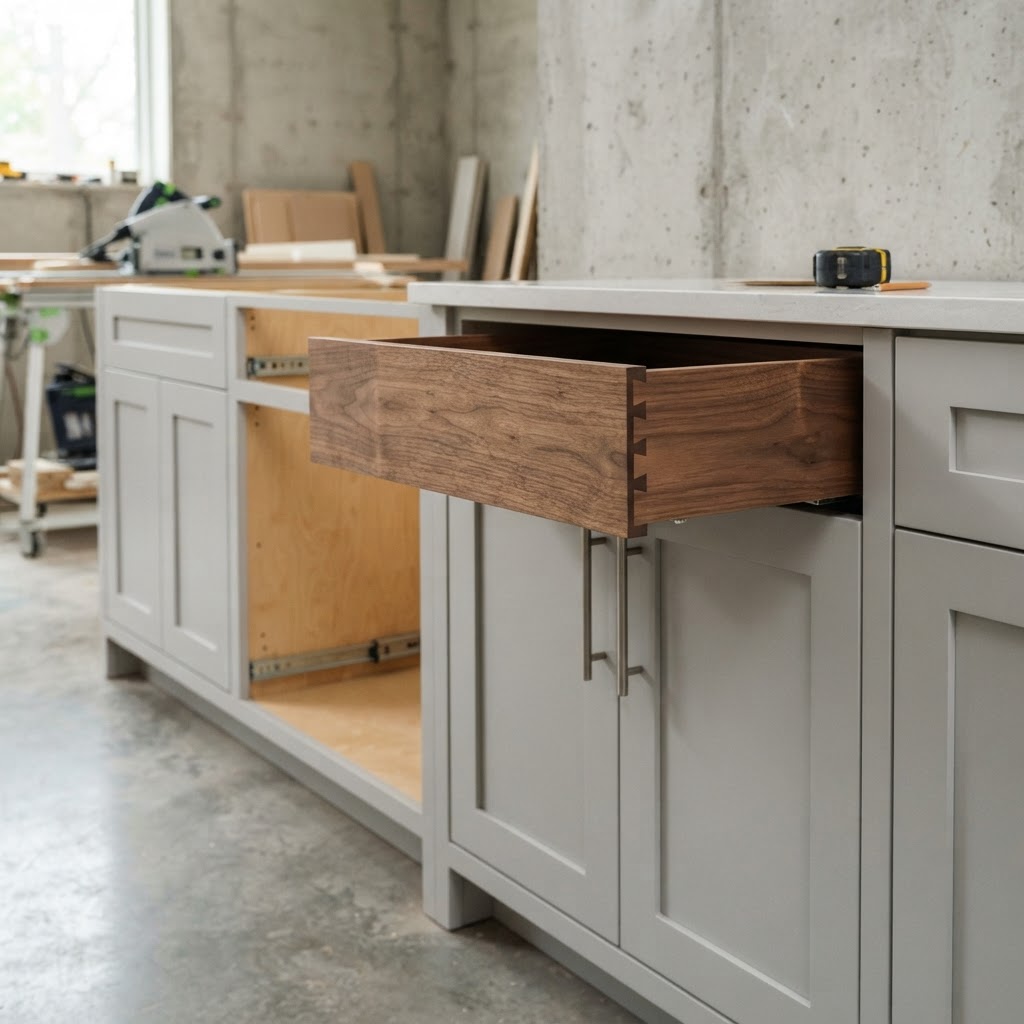
- Solid Dovetail Drawer Boxes: Heavy-duty, undermount soft-close slides require rigid drawer geometry. Solid wood dovetail construction prevents the drawer box from flexing when the self-closing tension engages.
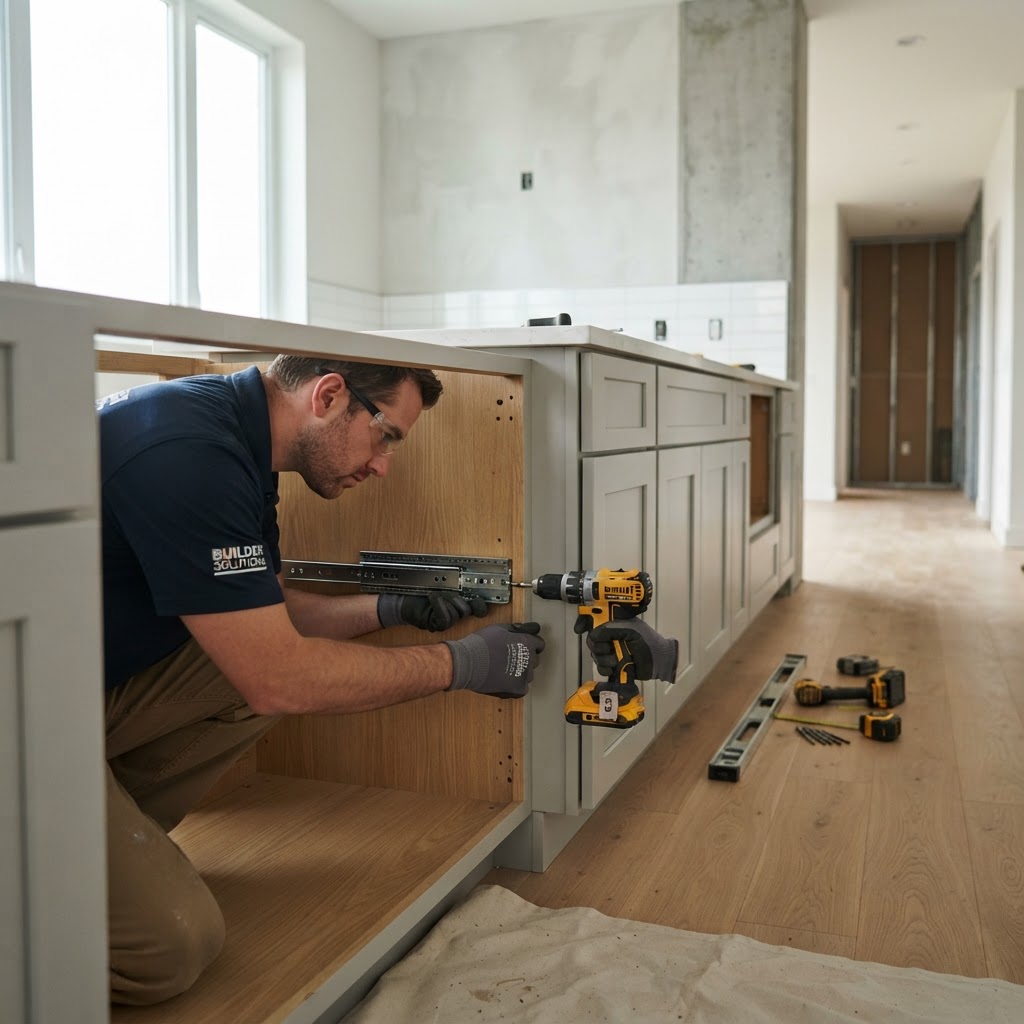
- Concealed Undermount Glides: Moving from side-mounted epoxy tracks to undermount soft-close slides keeps mechanical components protected from job-site dust, drywall powder, and debris during the final trim phase.
When cabinet boxes feature all-plywood construction and solid wood dovetail joinery as standard, the soft-close hardware performs reliably over decades rather than degrading within months.
4. Operational Simplicity: One Spec Across Your Entire Portfolio
Managing multiple cabinet lines—one with basic hardware for budget specs and another with upgraded hardware for custom builds—introduces friction to purchasing, warehousing, and installation. Installers waste time referencing varied drill patterns, sorting separate hardware boxes, or carrying multiple hinge styles in service vans.
Standardizing on a single high-performance cabinet platform simplifies field operations:
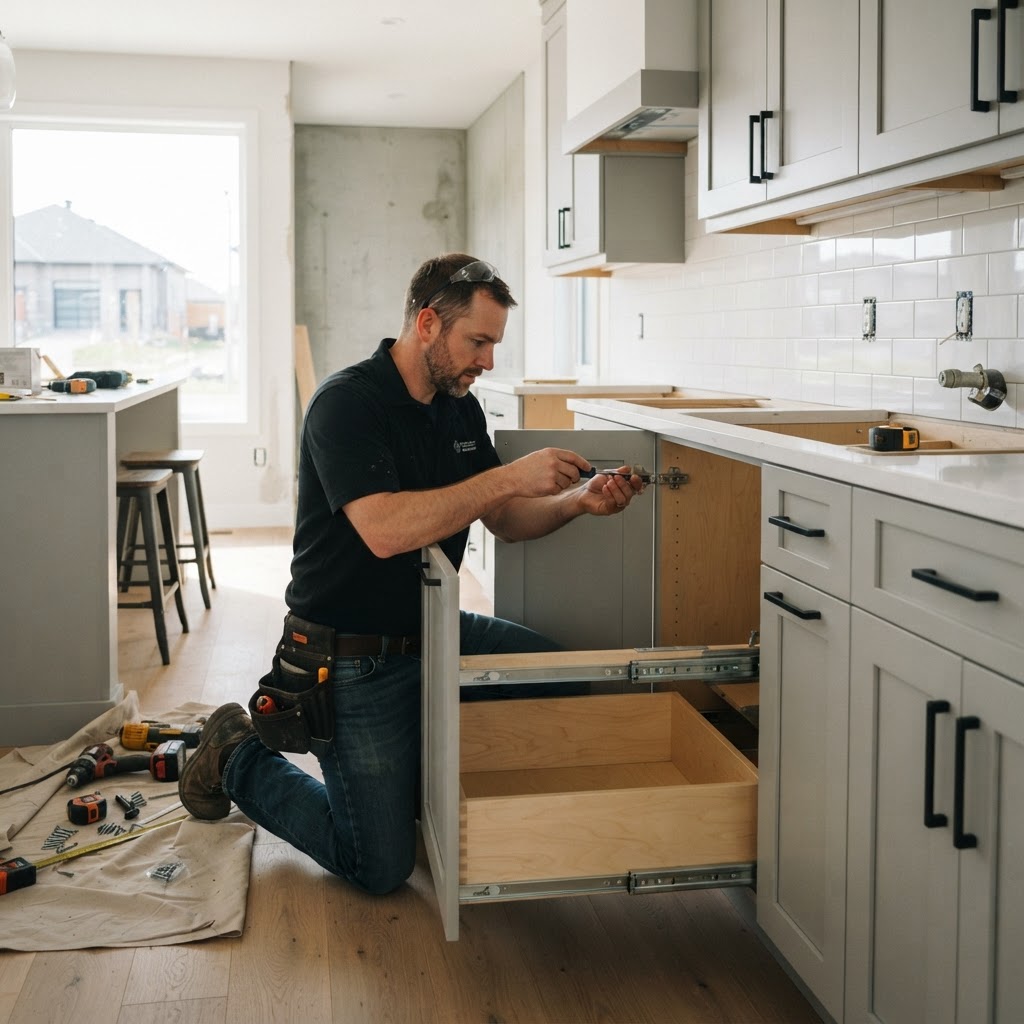
- Consistent Installation: Crews work with a uniform hinge cup pattern and single slide adjustment method, speeding up hanging and alignment on trim-out day.
- Simplified Punch Lists: Service techs only need to stock one replacement hinge type and slide profile for future adjustments.
- Predictable Estimating: Estimators can price residential jobs and commercial bidding documents faster without running separate line-item hardware upcharges.
The Supply Chain Factor: Premium Specs Without the Factory Delay
Historically, the primary reason builders settled for standard friction hardware was supply chain availability. Custom cabinet shops and large catalog manufacturers often attach an 8- to 12-week factory lead time to cabinetry ordered with integrated soft-close hinges, full-extension glides, and all-plywood boxes.
At Batch Cabinets, we eliminate the trade-off between baseline quality and schedule reliability. Headquartered at 1116 N Riverfront Dr in Mankato, MN, we serve general contractors, residential home builders, commercial remodelers, and lumberyard dealers throughout Minnesota—including Mankato, Rochester, Minneapolis, St. Paul, and statewide.
We do not treat quality as an upgrade:
- Standardized Build Quality: Every cabinet we carry features all-plywood box construction, solid dovetail drawer boxes, and integrated soft-close hinges and glides as standard equipment. There is no particleboard core to manage.
- True In-Stock Inventory: We stock our cabinetry locally, meaning you bypass lengthy factory lead times and keep your job schedules moving forward on time.
- Scalable Commercial Programs: From tier-priced volume orders for custom homes to full container programs for multi-unit and multifamily developments, our operations are tailored specifically to commercial trade logistics.
Upgrade Your Baseline Specification Today
Slamming doors, stripped hinge screws, and lengthy manufacturer delays do not have to be the cost of doing business. By partnering with a dedicated wholesale distributor that builds soft-close technology and all-plywood construction directly into the base product, you streamline job-site installation and protect your bottom line.
Contact the trade desk at Batch Cabinets today to request a project quote or open a builder account for your upcoming residential or multifamily builds.